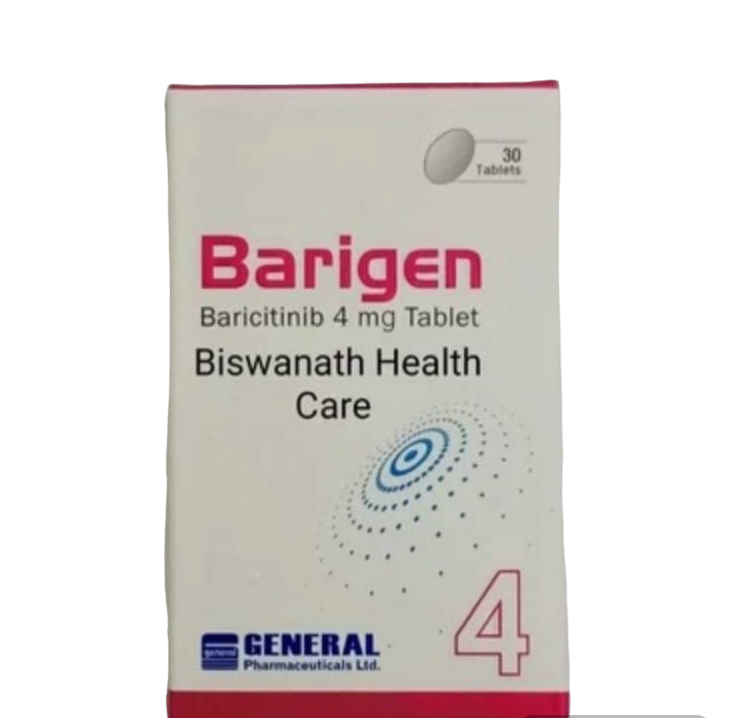
Baricitinib (Olumiant) 4 mg 30 tab
€136
For the treatment of active rheumatoid arthritis
In stock
Baricitinib (Olumiant) 4 mg 30 tab
Product Details
Baricitinib (Olumiant) 4 mg: A Selective Janus-Kinase Inhibitor in the Therapy of Autoimmune Inflammation
The era of targeted therapy in rheumatology and dermatology has been defined by the advent of molecules capable of selectively intervening in the intracellular signaling of pro-inflammatory cytokines without resorting to blanket immunosuppression. Baricitinib, marketed under the brand name Olumiant, is an oral, low-molecular-weight, selective, and reversible inhibitor of Janus kinases JAK1 and JAK2. A pack of 30 tablets at 4 mg is calibrated to provide one month of uninterrupted therapy. The drug is approved for three severe, often treatment-resistant conditions simultaneously: rheumatoid arthritis, atopic dermatitis, and alopecia areata. This cross-indication profile is not serendipitous — all three pathologies share a common pathogenic thread: the overproduction of JAK-dependent pro-inflammatory cytokines.
🧬 Mechanism of Action: Blocking the Cytokine Storm at the Level of Intracellular Signal Transduction
Janus kinases (JAKs) are a family of intracellular tyrosine kinases associated with the cytoplasmic domains of receptors for dozens of cytokines, including interleukins (IL-2, IL-4, IL-6, IL-7, IL-10, IL-12, IL-15, IL-21, IL-23) and interferons. When a cytokine binds to its cognate receptor, JAKs phosphorylate STAT signal transducer proteins, which dimerize and translocate to the nucleus, initiating the transcription of inflammatory genes.
Baricitinib selectively inhibits JAK1 and JAK2, while largely sparing JAK3. The clinical consequence is the potent suppression of multiple inflammatory cascades simultaneously:
- In Rheumatoid Arthritis: Blockade of IL-6-mediated signaling reduces the production of acute-phase reactants (CRP), systemic inflammation, and articular destruction. Concurrent suppression of IL-12/IL-23 and the interferon pathway modulates the adaptive immune response.
- In Atopic Dermatitis: Inhibition of IL-4 and IL-13 — the cardinal cytokines of the Th2 response — halts the allergic inflammatory cascade, reducing pruritus, cutaneous infiltration, and the breakdown of epidermal barrier function.
- In Alopecia Areata: Blockade of IL-15 and interferon-gamma arrests the cytotoxic T-cell assault on hair follicles, granting them the opportunity to exit a state of immunological collapse and re-enter the anagen growth phase.
📋 Therapeutic Niches: Three Diseases — A Single Molecular Key
1. Moderate-to-Severe Rheumatoid Arthritis (RA).
The drug is indicated for adult patients who have experienced an inadequate response or intolerance to one or more disease-modifying antirheumatic drugs (DMARDs). It can be deployed as monotherapy or in combination with methotrexate — the cornerstone first-line agent.
2. Moderate-to-Severe Atopic Dermatitis (AD).
Baricitinib is prescribed for adults who are candidates for systemic therapy — that is, those in whom topical glucocorticosteroids and calcineurin inhibitors fail to provide disease control. Concomitant use of topical corticosteroids is permissible and in fact enhances efficacy. Topical calcineurin inhibitors may be employed for sensitive regions (face, neck, diaper area, genitals).
3. Severe Alopecia Areata.
The most striking indication: baricitinib became the first systemic agent to be officially sanctioned for restoring hair regrowth in severe forms of autoimmune alopecia, inclusive of alopecia totalis and universalis.
💊 Dosing Regimen and Therapeutic Strategy
- Starting Dose: 4 mg (one tablet) once daily, irrespective of food intake.
- Dose Reduction to 2 mg Daily is appropriate within the following groups:
- Patients aged 75 years and above.
- Those with a history of chronic or recurrent infections.
- Patients who have achieved sustained disease control on the 4 mg dose — as a planned de-escalation of therapy.
- Treatment Duration:
- Atopic Dermatitis: Consider discontinuing therapy if no therapeutic effect is evident after 8 weeks.
- Alopecia Areata: Consider discontinuing if no improvement is seen after 36 weeks. Following a stable clinical response, treatment should be continued for at least several months to avert relapse.
- The benefit/risk ratio must be formally reassessed at regular intervals on an individualized, per-patient basis.
⚠️ Mandatory Pre-Treatment Screening and Safety Surveillance
Infections:
- The balance of benefit and risk must be meticulously weighed prior to initiation in patients with active, chronic, or recurrent infections.
- Should an infection unresponsive to standard therapy develop, baricitinib is temporarily withheld until the episode has fully resolved.
Tuberculosis (TB):
- Screening for both latent and active TB is mandatory before commencing therapy.
- The drug is contraindicated in active TB. In cases of untreated latent TB, a course of antituberculous treatment should be considered before initiating baricitinib.
Viral Hepatitis:
- HBV and HCV screening is compulsory. If HBV DNA is detected, consultation with a hepatologist is required regarding the necessity of discontinuing treatment.
Herpes Zoster Reactivation:
- Should shingles develop, therapy must be temporarily suspended until the episode resolves.
Hematological Monitoring:
- Therapy should not be initiated, or must be temporarily suspended, if the absolute neutrophil count falls below 1×10⁹/L, lymphocyte count below 0.5×10⁹/L, or hemoglobin below 8 g/dL.
- Elderly RA patients are at heightened risk for lymphocytosis. Rare instances of lymphoproliferative disorders have been reported.
Vaccination:
- Live attenuated vaccines are not recommended during or immediately prior to baricitinib therapy. Prior to treatment initiation, patients are advised to bring all immunizations up to date in accordance with current vaccination guidelines.
Pregnancy:
- Baricitinib is strictly contraindicated.
📦 Overdose and Storage
No specific toxic effects have been observed at single doses up to 40 mg; pharmacokinetic data indicate that more than 90% of an administered dose is eliminated within 24 hours. In the event of overdose, observation for signs and symptoms of adverse reactions and appropriate supportive care are recommended. Tablets must be stored in the original packaging, in a dry, light-protected location at room temperature.
Important notice
The photograph is provided for product identification. Packaging design may vary by batch or market. This page provides general product information and does not replace the package leaflet, diagnosis, prescription or advice from a doctor or pharmacist.
Display prices in:EUR