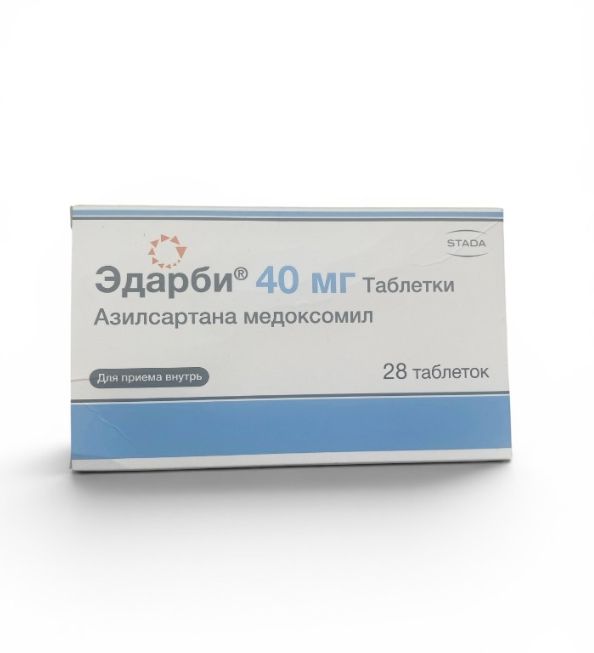
Edarbi 40 mg (azilsartan medoxomil) 28 pcs
€39
Arterial hypertension
In stock
Edarbi 40 mg (azilsartan medoxomil) 28 pcs
Product Details
Edarbi 40 mg Tablets: A Next-Generation Approach to 24-Hour Blood Pressure Control
What Is Edarbi 40 mg and Why Is It Prescribed?
Edarbi (international non-proprietary name: azilsartan medoxomil) is an innovative antihypertensive agent belonging to the pharmacological class of angiotensin II receptor blockers (ARBs), commonly referred to as sartans. Manufactured by the Japanese pharmaceutical corporation Takeda, it is indicated for the management of essential (primary) hypertension in adults.
What distinguishes this molecule from earlier-generation ARBs is its pharmacological profile: it reliably and consistently reduces blood pressure over a full 24-hour period following a single daily oral dose, offering patients a convenient and effective once-daily treatment option.
Pharmaceutical Form and Appearance
- Dosage Form: Film-coated tablets.
- Strength: Each tablet contains 40 mg of azilsartan medoxomil.
- Appearance: White, round, biconvex tablets debossed with «ASL» on one side and «40» on the reverse.
- Pack Size: A carton contains 28 tablets — precisely one month of continuous therapy.
How Edarbi Works: The Mechanism of Action Explained
The renin-angiotensin-aldosterone system (RAAS) plays a central role in the pathogenesis of hypertension. When the body perceives a drop in blood pressure or a sodium deficit, it triggers a hormonal cascade that culminates in the production of angiotensin II — one of the most potent vasoconstrictors known.
Angiotensin II exerts its pathological effects by binding to AT1 receptors located on vascular smooth muscle cells and in the adrenal cortex. This interaction triggers:
- Vasoconstriction: Narrowing of arteries and arterioles, which increases total peripheral resistance.
- Sodium and Water Retention: Stimulation of aldosterone secretion from the adrenal glands, leading to expanded circulating blood volume.
- Structural Remodeling: Promotion of pro-inflammatory and pro-fibrotic pathways that contribute to vascular stiffness and left ventricular hypertrophy.
Azilsartan is a prodrug. Following oral absorption, it is rapidly hydrolyzed to its active moiety, which acts as a potent, selective, and insurmountable antagonist of the AT1 receptor. By occupying the receptor binding site, it prevents angiotensin II from exerting its hypertensive effects.
Key Therapeutic Benefits:
- Sustained Vasodilation: Relaxation of vascular smooth muscle, reducing peripheral resistance.
- Natruretic Effect: Reduced aldosterone levels facilitate the excretion of excess sodium and water.
- End-Organ Protection: Clinical studies demonstrate the potential for regression of left ventricular hypertrophy and slowing of renal disease progression.
Clinical Advantage: Peak antihypertensive efficacy is achieved after 2 to 4 weeks of consistent daily intake, with Edarbi demonstrating a high responder rate even when used as monotherapy.
Edarbi 40 mg: Dosage and Administration Guidelines
Optimal therapeutic outcomes depend upon strict adherence to the prescribed dosing regimen.
Standard Dosing Protocol
- Recommended Starting Dose: 40 mg (one tablet) once daily.
- Timing of Administration: Edarbi may be taken with or without food, as meals do not impact its bioavailability. To build a consistent routine and minimize the risk of missed doses, patients are advised to take the tablet at approximately the same time each day with a glass of water.
- Dose Titration: If blood pressure remains inadequately controlled after several weeks, the treating physician may escalate the dose to the maximum of 80 mg (two tablets) once daily.
Dose Adjustments in Special Populations
| Patient Population | Dosing Recommendation | Clinical Rationale |
|---|---|---|
| Elderly (≥ 75 years) | Consider initiating at 20 mg once daily | Increased susceptibility to orthostatic hypotension |
| Mild-to-Moderate CKD | No dose adjustment required | Regular renal function monitoring is essential |
| End-Stage Renal Disease | Limited clinical experience | Prescribe with extreme caution |
| Hepatic Impairment (Child-Pugh A-B) | Use with caution | Monitor ALT/AST levels regularly |
| Volume Depletion | Initiate at 20 mg once daily | Correct fluid and electrolyte deficits beforehand |
Managing a Missed Dose:
If a dose is forgotten, it should be taken as soon as the patient remembers. However, if it is nearly time for the next scheduled dose, the missed dose must be skipped. Doubling the dose to compensate is strictly inadvisable.
Contraindications: When Edarbi Should Not Be Used
Several absolute clinical scenarios preclude the use of azilsartan medoxomil:
- Pregnancy. ARBs exert direct fetotoxic effects. Exposure during the second and third trimesters is associated with oligohydramnios, fetal renal dysfunction, and cranial bone hypoplasia. Edarbi must be discontinued immediately upon confirmation of pregnancy.
- Hypersensitivity to the active substance or to any of the tablet's excipients.
- Concomitant Use with Aliskiren in patients with diabetes mellitus or moderate-to-severe renal impairment. Dual RAAS blockade in this cohort significantly elevates the risk of hyperkalemia, acute kidney injury, and hypotension.
- Severe Hepatic Impairment (Child-Pugh Class C, score ≥ 10).
- Pediatric Population. The safety and efficacy of Edarbi in children and adolescents have not been established.
Side Effects and Tolerability Profile
Clinical trial data and post-marketing surveillance indicate that Edarbi is generally well tolerated. Most adverse events are mild to moderate in intensity and rarely necessitate treatment discontinuation.
| Frequency | Adverse Reactions |
|---|---|
| Common (≥ 1/100) | Dizziness, diarrhea |
| Uncommon (≥ 1/1000) | Arterial hypotension, muscle spasms, asthenia, peripheral edema, nausea, skin rash, pruritus |
| Rare | Angioedema (Quincke's edema) |
| Laboratory Abnormalities | Elevated serum creatinine, elevated uric acid, hyperkalemia |
Precautionary Note: At the initiation of therapy, patients who drive vehicles or operate hazardous machinery should exercise caution due to the potential risk of dizziness.
Drug Interactions: What to Tell Your Doctor
Before starting Edarbi, it is imperative that the prescribing physician is informed of all medications the patient is taking to avoid clinically significant drug interactions.
- Lithium: ARBs reduce the renal clearance of lithium, potentially leading to toxic accumulation and neurotoxicity.
- NSAIDs (Non-Steroidal Anti-Inflammatory Drugs): These agents can attenuate the antihypertensive efficacy of Edarbi and, in patients with compromised renal function, may precipitate acute kidney injury.
- Potassium-Sparing Diuretics (spironolactone, eplerenone) and Potassium Supplements: Concurrent use increases the risk of developing clinically significant hyperkalemia.
- Dual RAAS Blockade (ACE inhibitors + ARBs, or Aliskiren-containing products): This combination is generally not recommended due to an elevated risk of hypotension, syncope, and renal failure.
Frequently Asked Questions About Edarbi 40 mg
How does Edarbi differ from other ARBs like Losartan or Valsartan?
Edarbi (azilsartan) is a later-generation ARB characterized by high affinity for and slow dissociation from the AT1 receptor. Pharmacologically, this translates into potent and stable 24-hour blood pressure control, often surpassing the efficacy of older sartans at standard doses.
Can I consume alcohol while taking Edarbi?
Alcohol consumption may potentiate the blood-pressure-lowering effect of Edarbi, potentially leading to symptomatic hypotension or dizziness. It is advisable to abstain from alcohol during therapy.
How quickly will my blood pressure drop?
An initial reduction in blood pressure may be observed within a few hours of the first dose. However, the stable and maximal therapeutic effect requires 2 to 4 weeks of uninterrupted daily intake.
Do I need to follow a special diet?
No specific diet is mandatory. However, patients are advised to limit their dietary sodium intake and to avoid using potassium-based salt substitutes without prior consultation with their physician.
Important notice
The photograph is provided for product identification. Packaging design may vary by batch or market. This page provides general product information and does not replace the package leaflet, diagnosis, prescription or advice from a doctor or pharmacist.
Display prices in:EUR