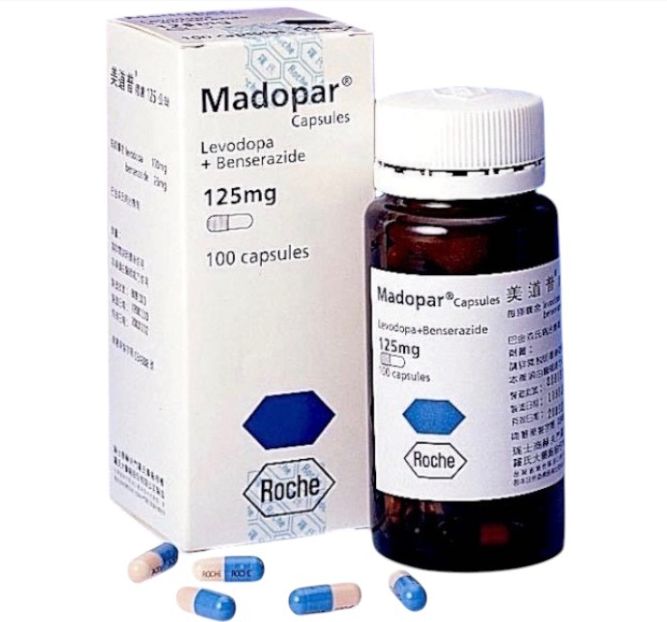
Madopar 125 mg 100 capsules
€46
Parkinson's disease
In stock
Madopar 125 mg 100 capsules
Product Details
Madopar 125, capsules, 100 mg + 25 mg, 100 pcs
Parkinson’s disease is a neurodegenerative disorder driven by the progressive loss of dopamine-producing neurons within the substantia nigra. The resulting dopamine deficit disrupts the finely calibrated circuitry of the basal ganglia, trapping the patient in the grip of the classic triad: resting tremor, muscular rigidity, and bradykinesia. Madopar 125 is a fixed-combination preparation that has, over decades, become a cornerstone of antiparkinsonian pharmacotherapy. Each capsule encapsulates a synergistic pair: 100 mg of levodopa and 25 mg of benserazide. The 100-capsule pack is designed to provide therapeutic continuity, sparing the patient from frequent pharmacy visits.
🧠 The Levodopa-Benserazide Tandem: Biochemical Rationale for Combination
Levodopa (L-DOPA) is the metabolic precursor of dopamine and the only agent in this class capable of crossing the blood-brain barrier. In its unmodified form, however, it confronts two fundamental obstacles:
- Peripheral Metabolism. The enzyme aromatic amino acid decarboxylase (DOPA-decarboxylase) destroys the lion’s share of levodopa long before it reaches the brain — within the intestinal wall, the liver, and the vascular endothelium.
- Toxic Burden. The peripheral dopamine generated from this destruction provokes nausea, vomiting, and orthostatic hypotension, while contributing nothing to central nervous system function.
Benserazide addresses both challenges simultaneously. As an inhibitor of peripheral DOPA-decarboxylase, it:
- Blocks the premature conversion of levodopa to dopamine outside the brain.
- Dramatically elevates the bioavailability of levodopa for the CNS — up to 60–80% of the ingested dose reaches the striatum.
- Virtually eliminates peripheral dopaminergic side effects — nausea, hypotension, and anorexia.
The net result: a compact capsule embodying the principle of “maximum central efficacy combined with minimum peripheral toxicity.”
📋 Therapeutic Spectrum
Madopar 125 is deployed in two principal clinical domains:
- Parkinson’s Disease and Parkinsonism. The drug serves as a first-line agent for patients whose motor symptoms — stiffness, slowness of movement, tremor — have begun to measurably erode daily functional capacity. It is effective across all disease stages and is routinely combined with dopamine receptor agonists, MAO-B inhibitors, and other adjunctive agents.
- Restless Legs Syndrome (RLS). In cases where non-pharmacological strategies have been exhausted, and the sensory and motor symptoms — an irresistible urge to move the legs, discomfort at rest that worsens in the evening and at night — are demolishing sleep architecture, Madopar may be prescribed to provide relief from this distressing condition.
💊 Available Formulations and Administration Rules: Flexibility for the Patient
Madopar is available in several dosage forms; the specific selection is dictated by the clinical picture and the patient’s swallowing ability:
- Standard Capsules (125 mg). Swallowed whole, without chewing.
- Tablets. May be crushed to facilitate ingestion in patients with dysphagia.
- Dispersible Tablets for Oral Suspension. Covered with a small amount of water, the tablet disintegrates rapidly and completely to yield a milky-white suspension. Because sediment accumulates swiftly, the suspension must be stirred immediately before administration. Critical rule: the prepared suspension must be consumed within half an hour.
Universal Administration Guidance:
- Whenever possible, the medication should be taken at least half an hour before meals. Dietary protein competes with levodopa for transport systems in both the gut and the blood-brain barrier, potentially diminishing and delaying clinical effect.
- The dosing schedule and frequency are titrated by the treating physician on a strictly individual basis. Dose optimization is an art that requires balancing symptom control against the minimization of dyskinesias.
- Gradual Withdrawal. The drug must never be discontinued abruptly. Sudden interruption of dopaminergic stimulation can precipitate a neuroleptic malignant-like syndrome — a life-threatening emergency characterized by hyperthermia, severe muscular rigidity, and autonomic instability.
⚠️ Mandatory Physician Briefing: A Pre-Treatment Checklist
Before therapy commences, the patient must disclose a complete clinical portrait. Particular attention is warranted for:
- Hypersensitivity to levodopa, benserazide, or any excipient in the formulation.
- Severe hepatic and renal impairment.
- Active gastric and/or duodenal ulcer disease.
- Narrow-angle glaucoma.
- Cardiovascular conditions: arrhythmias, unstable angina, decompensated heart failure.
- Decompensated endocrinopathies.
Drug-Drug Interactions the Physician Must Be Aware Of:
- Other antiparkinsonian agents (adjustment of combination therapy).
- Sympathomimetics.
- Gastric acid suppressants.
- Opioid analgesics.
- Antihypertensive drugs containing reserpine (dopamine antagonism).
- Iron preparations and vitamin B₆ (pyridoxine) — the latter accelerates peripheral levodopa degradation.
Pregnancy and Lactation: Madopar is not prescribed. The drug is contraindicated in women of childbearing potential who are not employing an effective contraceptive method.
📊 Adverse Reaction Profile and Everyday Safety
The spectrum of potential side effects encompasses:
- Psychiatric Domain: Agitation, anxiety, hallucinations, delirium, nightmares, transient confusion, depression, sleep disturbances, pathological somnolence, and episodes of sudden sleep onset.
- Cardiovascular System: Arrhythmias, orthostatic blood pressure fluctuations.
- Gastrointestinal Tract: Anorexia, appetite loss, nausea, vomiting, diarrhea, dry mouth.
- Neurology: Headache.
- Laboratory Shifts: Transient changes in blood cell counts.
- Cutaneous Manifestations: Urticaria, allergic rash.
Specific Warning for Drivers: Somnolence and sudden sleep-onset episodes occurring during Madopar therapy pose a direct danger when driving a motor vehicle or operating moving machinery. The patient must discuss the permissibility of driving with the treating physician on a case-by-case basis.
📦 Storage and Responsible Handling
Capsules must be kept in the tightly closed original manufacturer’s packaging, stored in a location inaccessible to children, and shielded from both moisture and light. Use of the medication beyond its printed expiry date is strictly forbidden. A drug prescribed for one individual must never be supplied to another person — even one sharing an identical diagnosis.
Important notice
The photograph is provided for product identification. Packaging design may vary by batch or market. This page provides general product information and does not replace the package leaflet, diagnosis, prescription or advice from a doctor or pharmacist.
You May Also Like

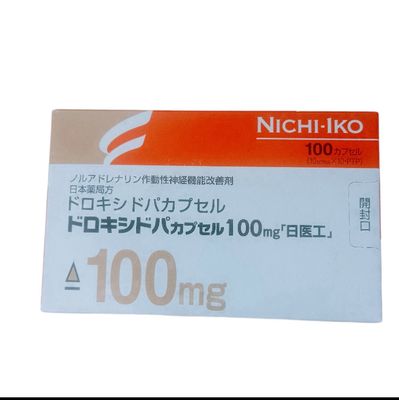
Droxidopa 100 mg (Nichi-Iko) 100 caps.
Droxidopa 100 mg (Nichi-Iko) 100 caps.
Drug for the treatment of Parkinson's disease
€140
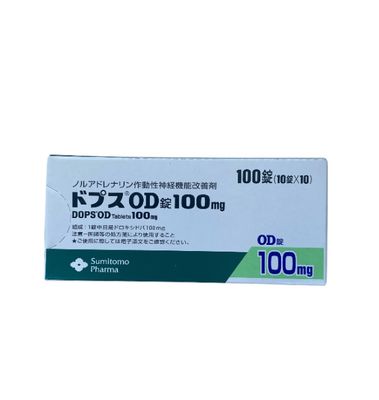
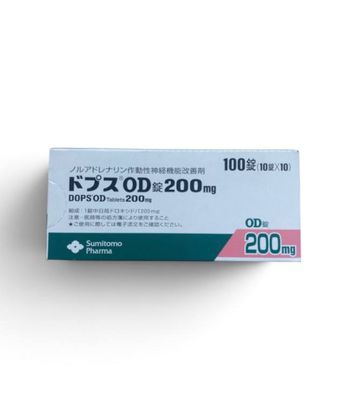
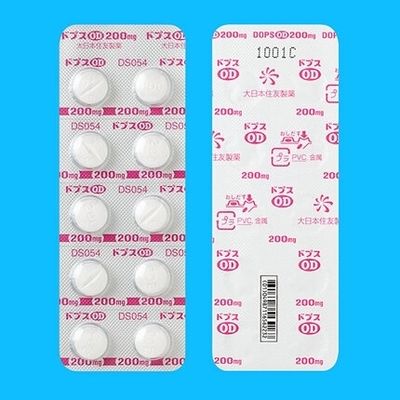
DOPS OD (Droxidopa) 200 mg 100 tablets
DOPS OD (Droxidopa) 200 mg 100 tablets
Droxidopa 200 mg, 100 orally disintegrating tablets — prescription noradrenaline precursor for Parkinson's disease and neurogenic orthostatic hypotension (Japan)
€140
Display prices in:EUR