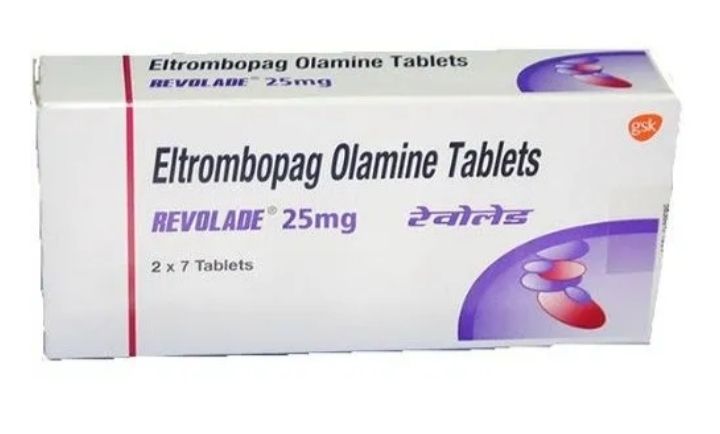
Revolade (Eltrombopag) 25 mg 14 tab.
€238
Treatment of low platelet count
In stock
Revolade (Eltrombopag) 25 mg 14 tab.
Product Details
Revolade 25 mg (Eltrombopag): A Thrombopoietin Receptor Agonist for the Restoration of the Platelet Lineage
Thrombocytopenia is a condition in which the platelet count drops below a critical threshold, transforming every microscopic vascular breach into a potential source of uncontrolled hemorrhage. Revolade is an orally bioavailable thrombopoietin receptor (TPO-R) agonist delivering 25 mg of eltrombopag (as eltrombopag olamine — 31.9 mg). Unlike many other hematological agents, it is not a protein but a low-molecular-weight synthetic compound capable of gastrointestinal absorption that selectively stimulates thrombopoiesis. This formulation is intended for oral administration and is deployed in severe cytopenias refractory to other therapeutic modalities.
🧬 Molecular Mechanism: Mimicking Thrombopoietin Without Structural Homology
Endogenous thrombopoietin (TPO) is a glycoprotein hormone produced primarily by the liver. It binds to TPO receptors expressed on the surface of megakaryocytes — the giant bone marrow cells that ultimately fragment into thousands of circulating platelets. In immune thrombocytopenic purpura (ITP) and aplastic anemia, this mechanism fails: either platelets are prematurely destroyed by autoantibodies, or the marrow fails to generate an adequate number of megakaryocytes.
Eltrombopag’s uniqueness resides in its interaction with the transmembrane domain of the TPO receptor — a site distinct from that recognized by the natural ligand. This is a critical distinction: endogenous TPO and eltrombopag do not compete for the same binding site; instead, their actions are additive. The result is a cascade of intracellular signaling events (JAK/STAT and MAPK pathways) that induces:
- The proliferation and differentiation of megakaryocytic progenitor cells within the bone marrow.
- An increase in megakaryocyte ploidy and terminal maturation.
- Enhanced production of functionally competent platelets capable of participating adequately in hemostasis.
📋 Therapeutic Niches
Revolade is prescribed in three core clinical scenarios united by a common denominator — a severe, life-threatening platelet deficit:
1. Chronic Immune (Idiopathic) Thrombocytopenic Purpura (ITP).
An autoimmune disorder wherein antibodies target and destroy the patient’s own platelets. Eltrombopag is indicated in adults and children with persistent or chronic ITP refractory to glucocorticosteroids, intravenous immunoglobulins, or splenectomy. The therapeutic goal is to achieve and sustain a safe platelet count (generally exceeding 50,000/µL), adequate to avert spontaneous bleeding episodes.
2. Thrombocytopenia Associated with Chronic Hepatitis C Virus (HCV) Infection.
Interferon-based antiviral therapy — a cornerstone of HCV management — frequently provokes profound thrombocytopenia, which in turn compels dose reductions or outright interruption of essential treatment. Revolade enables the maintenance of platelet levels compatible with the continuation of a full-fledged antiviral regimen, thereby optimizing the odds of viral eradication.
3. Severe Aplastic Anemia (SAA).
In SAA, the bone marrow suffers a catastrophic loss of its capacity to generate blood cells. Eltrombopag is used in patients with refractory SAA who have failed to respond to immunosuppressive therapy or who are ineligible for hematopoietic stem cell transplantation. Within this population, the drug has demonstrated the ability to stimulate not only the megakaryocytic lineage, but also the erythroid and granulocytic lineages — a unique attribute among TPO-receptor agonists.
📊 Tablet Composition: Active Core and Excipient Matrix
The 25 mg tablet contains eltrombopag as eltrombopag olamine. The core excipients include mannitol (E421), microcrystalline cellulose, povidone, sodium starch glycolate (type A), and magnesium stearate.
The film coating (Opadry® White YS-1-7706-G) comprises hypromellose, titanium dioxide (E171), macrogol 400, and polysorbate 80.
⚠️ Key Safety Alerts and Hepatotoxicity
Revolade therapy is associated with the risk of serious adverse events that demand rigorous laboratory surveillance:
- Hepatotoxicity. The drug can elevate serum transaminases and bilirubin levels. Liver function must be monitored at baseline, every two weeks during the dose-adjustment phase, and monthly once a stable dose is established. A confirmed, clinically significant enzyme rise may warrant treatment suspension.
- Thrombotic Complications. An excessive rise in platelet count carries the risk of both venous and arterial thrombotic events. The dose should be titrated to achieve the minimum safe platelet level, not normalization.
- Cataracts. Development or progression of cataracts has been documented in clinical studies. An ophthalmological examination is recommended prior to therapy initiation and periodically throughout the treatment course.
- Bone Marrow Fibrosis. A theoretical risk of reticulin deposition exists with prolonged TPO-receptor stimulation. Should abnormalities appear on the peripheral blood smear (e.g., teardrop-shaped erythrocytes), a bone marrow biopsy may be warranted.
📦 Storage
The tablets must be retained in the original packaging, in a dry, light-protected environment at room temperature. Access by children must be entirely precluded.
📦Find out about the delivery to your country on WhatsApp
Important notice
The photograph is provided for product identification. Packaging design may vary by batch or market. This page provides general product information and does not replace the package leaflet, diagnosis, prescription or advice from a doctor or pharmacist.
Display prices in:EUR