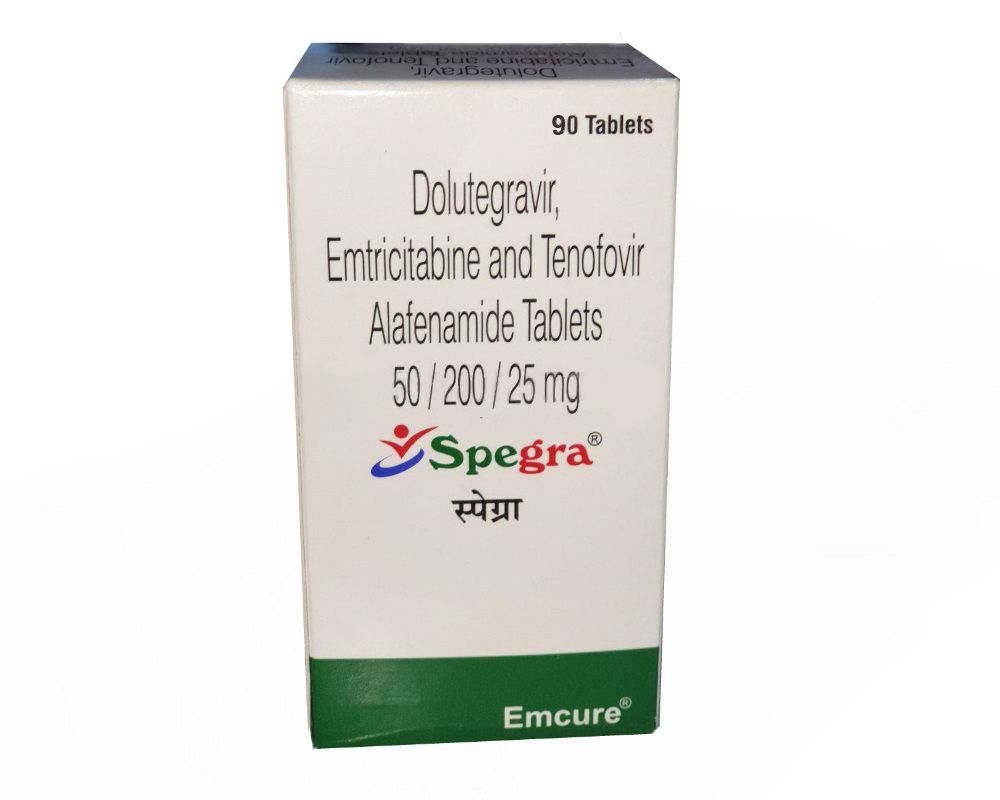
Spegra 90 Tab.
Product Details
Spegra (Tenofovir Alafenamide + Emtricitabine + Dolutegravir): A Single-Tablet Triple Antiretroviral Regimen
Modern antiretroviral therapy (ART) has undergone a colossal evolution — from multi-component regimens involving dozens of daily pills to elegant, all-in-one fixed-dose combinations. Spegra epitomizes this principle: each tablet encapsulates three potent active agents endowed with complementary mechanisms for suppressing the human immunodeficiency virus (HIV-1). The manufacturer supplies a pack of 90 tablets — a three-month reserve designed for uninterrupted therapy, which is critically essential for maintaining an undetectable viral load and preserving immune function.
🧬 Drug Architecture: Three Molecules — Three Targets
Spegra combines a fixed dose of three antiretroviral agents, each attacking the virus at a distinct stage of its life cycle:
1. Dolutegravir (50 mg) — A Second-Generation Integrase Inhibitor.
Integrase is the HIV enzyme responsible for inserting the viral DNA into the genome of the human host cell. Without this critical step, the virus cannot complete its replication. Dolutegravir binds to the active site of integrase and blocks strand transfer, thereby preventing proviral integration. Its advantages over earlier-generation agents include:
- A high genetic barrier to the emergence of resistance.
- Once-daily oral administration without the need for pharmacokinetic boosting.
- Potent and rapid suppression of viral load.
2. Emtricitabine (200 mg) — A Nucleoside Reverse Transcriptase Inhibitor (NRTI).
Reverse transcriptase is the enzyme that converts viral RNA into DNA. Emtricitabine, a cytidine analogue, is incorporated into the elongating DNA chain and terminates its synthesis. It is active against both HIV-1 and the hepatitis B virus (HBV).
3. Tenofovir Alafenamide (25 mg) — A Nucleotide Reverse Transcriptase Inhibitor (NtRTI).
This represents an advanced prodrug of tenofovir, engineered to solve the principal drawbacks of its predecessor (tenofovir disoproxil fumarate) — namely, nephrotoxicity and loss of bone mineral density. Tenofovir alafenamide (TAF) exhibits greater stability in plasma and selectively penetrates lymphoid cells, the very compartment where HIV replication occurs. The clinical dividends include:
- Markedly reduced systemic tenofovir exposure.
- Significantly diminished burden on the renal tubules.
- A lesser impact on bone metabolism, with fully preserved antiviral potency.
📋 Therapeutic Niche and Clinical Rationale
Spegra does not cure HIV infection — to date, the eradication of the virus from the body remains an elusive goal. Its mission lies elsewhere:
- Suppressing viral replication to levels below the limit of detection by laboratory assays (an undetectable viral load).
- Restoring and preserving the CD4+ T-lymphocyte population — the key immune cells decimated by HIV.
- Preventing disease progression to the AIDS stage and the associated opportunistic infections.
- Reducing the risk of sexual transmission of the virus: a person with a sustained undetectable viral load does not transmit HIV (the «U = U» principle — Undetectable = Untransmittable).
💊 Dosing Regimen and the Discipline of Adherence
- Dose: One tablet, once daily.
- Administration: The tablet may be taken irrespective of meals.
- Guidance for Minimizing Neuropsychiatric Effects: In the event of dizziness or unusual dreams, taking the dose immediately before bedtime on an empty stomach is permissible — this measure lessens the burden on the central nervous system.
The absolute ART imperative is adherence. Missed doses are inadmissible. They create temporal windows during which the virus can multiply, leading to two catastrophic consequences: a spike in viral load and the selection of drug-resistant strains. Should a dose be missed, the patient should take the tablet as soon as remembered — provided sufficient time remains before the next scheduled dose. Doubling the dose is strictly forbidden.
⚠️ Critical Contraindications
- Concomitant administration with the fixed-dose combination of Elbasvir/Grazoprevir (hepatitis C therapy) is categorically prohibited.
- Hypersensitivity to any of the three active pharmaceutical ingredients or any excipient in the tablet.
- Pregnancy. Spegra is contraindicated during gestation. Women of childbearing potential receiving this therapy must employ reliable contraceptive measures.
📊 Adverse Reaction Profile
The following adverse effects may be observed during the course of therapy:
- Common: nausea, diarrhea, vomiting, abdominal discomfort, fatigue, headache.
- Infectious phenomena at therapy initiation: upper respiratory tract infections.
- Laboratory shifts: elevation of serum creatinine (renal function monitoring is mandatory), transient thrombocytopenia.
- Less frequent, but possible: heartburn, skin rash, back pain, taste disturbances, cough, peripheral edema, dizziness.
Hypersensitivity reactions demand immediate medical attention. They may present as a generalized rash, pyrexia, and signs of visceral organ involvement.
🛡️ Resistance and Monitoring
Despite dolutegravir’s high genetic barrier, the risk of resistance emergence is ever-present — particularly when the prescribed intake schedule is disregarded. The treating physician is obliged to monitor the patient’s viral load regularly, in accordance with established clinical protocols. Any confirmed rise in viral load warrants resistance mutation testing and the potential revision of the antiretroviral regimen.
📦 Storage Requirements
Tablets must be stored in a cool, dry place, secured from access by children. The original packaging affords protection from both moisture and light.
📦Find out about the delivery to your country on WhatsApp
Important notice
The photograph is provided for product identification. Packaging design may vary by batch or market. This page provides general product information and does not replace the package leaflet, diagnosis, prescription or advice from a doctor or pharmacist.
Display prices in:EUR