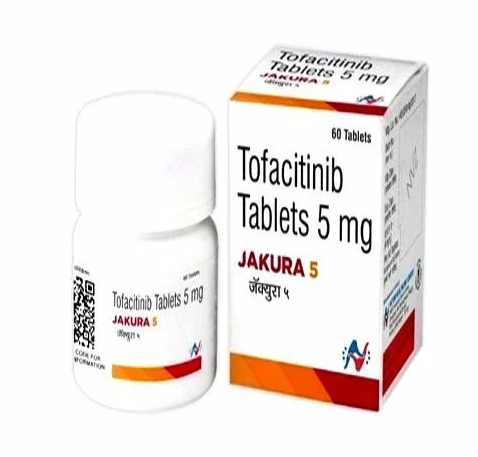
Tofacitinib 5 mg 60 Tab
€89
Rheumatoid arthritis
In stock
Tofacitinib 5 mg 60 Tab
Product Details
Tofacitinib 5 mg: A Janus-Kinase Inhibitor for the Targeted Therapy of Immune-Mediated Inflammatory Diseases
Rheumatology, dermatology, and gastroenterology share a common challenge: many severe chronic diseases are rooted in uncontrolled inflammation driven by the overproduction of pro-inflammatory cytokines. Tofacitinib is a synthetic, orally bioavailable Janus kinase (JAK) inhibitor manufactured by India’s Sakura. Each tablet delivers 5 mg of the active substance, and the 60-tablet pack covers a full month of therapy at the standard twice-daily dosing schedule. The drug’s defining feature is its capacity to intercept the intracellular signaling of numerous cytokines simultaneously, thereby providing a broad clinical remit — from rheumatoid arthritis to ulcerative colitis.
🧬 Mechanism of Action: JAK Signaling Blockade as a Universal Anti-Inflammatory Key
Janus kinases (JAK1, JAK2, JAK3, and TYK2) are intracellular enzymes constitutively associated with the cytoplasmic domains of interleukin and interferon receptors. When a cytokine engages its receptor, JAKs phosphorylate and activate STAT signal transducer proteins, which dimerize and translocate to the nucleus to initiate the transcription of inflammatory genes.
Tofacitinib predominantly inhibits JAK1 and JAK3, thereby disrupting signal transduction from a broad array of cytokines implicated in autoimmune pathogenesis:
- Pro-inflammatory interleukins (IL-2, IL-4, IL-6, IL-7, IL-9, IL-15, IL-21).
- Type I and type II interferons.
The net result is the comprehensive suppression of both innate and adaptive immune responses, translating clinically into the reduction of pain, swelling, joint stiffness, psoriatic plaques, skin lesions, and colonic mucosal inflammation.
📋 Therapeutic Niches: From Joints to the Intestine
Tofacitinib is approved for the therapy of a range of immune-mediated inflammatory diseases in adults, as well as for polyarticular juvenile idiopathic arthritis in children aged 2 years and older:
1. Rheumatoid Arthritis (RA).
Prescribed for moderate-to-high disease activity in patients who have experienced an inadequate response to one or more disease-modifying antirheumatic drugs (DMARDs), including methotrexate.
2. Psoriatic Arthritis (PsA).
Indicated for adults with active joint inflammation on a background of psoriasis, refractory to standard DMARD therapy.
3. Ankylosing Spondylitis.
Employed in patients with active disease in whom conventional therapy has failed to deliver adequate symptom control.
4. Plaque Psoriasis.
Prescribed for moderate-to-severe chronic forms when systemic therapy or phototherapy is indicated.
5. Ulcerative Colitis (UC).
Used for both the induction and maintenance of remission in patients with moderate-to-severe disease activity who have not responded to, lost response to, or are intolerant of glucocorticosteroids, azathioprine, 6-mercaptopurine, or tumor necrosis factor (TNF) inhibitors.
6. Polyarticular Juvenile Idiopathic Arthritis.
The single pediatric indication, for patients with a body weight of 40 kg or greater.
💊 Dosing Regimen: A Differentiated Approach
The tofacitinib dose depends on the specific diagnosis and clinical situation:
| Indication | Standard Dose |
|---|---|
| Rheumatoid Arthritis | 5 mg twice daily |
| Psoriatic Arthritis | 5 mg twice daily |
| Ankylosing Spondylitis | 5 mg twice daily |
| Plaque Psoriasis | 10 mg twice daily |
| Ulcerative Colitis (induction) | 10 mg twice daily (8 weeks) |
| Ulcerative Colitis (maintenance) | 5 mg or 10 mg twice daily |
| Juvenile Arthritis (≥ 40 kg) | 5 mg twice daily |
Dose Adjustment:
- Dose reduction is indicated in renal or hepatic impairment and upon co-administration of certain interacting medications.
- Should the therapeutic response wane on 5 mg twice daily, escalation to 10 mg may be considered for specific indications.
- Therapy is paused or discontinued if the absolute lymphocyte count, neutrophil count, or hemoglobin level falls below critical thresholds.
Administration Rules:
- Tablets are taken orally, with or without food.
- A missed dose must not be compensated by doubling the subsequent one — the next tablet should be taken at the usual time.
- The duration of therapy is determined by the treating physician. Independent discontinuation is strictly inadmissible.
⚠️ Absolute Contraindications: Firm Safety Boundaries
Tofacitinib is a potent immunomodulator, and its prescription is excluded in the setting of:
- Hypersensitivity to tofacitinib or any tablet component.
- Severe hepatic dysfunction.
- Infection with hepatitis B and/or C viruses.
- Recent or planned vaccination with live vaccines.
- Concomitant use of biologic agents (TNF inhibitors, interleukin antagonists, anti-CD20 monoclonal antibodies, anti-integrins) or potent immunosuppressants (azathioprine, cyclosporine, tacrolimus).
- Severe active infection, including localized forms.
- Lactase deficiency, lactose intolerance, or glucose-galactose malabsorption.
Additional Prohibition on the 10 mg Twice-Daily Dose:
- Concurrent use of combined hormonal contraceptives or hormone replacement therapy.
- Diagnosed heart failure.
- A history of venous thromboembolism (deep vein thrombosis, pulmonary embolism).
- Hereditary coagulation disorders.
- Diagnosed malignancies.
- Planned major surgery during the course of therapy.
📊 Safety Monitoring
Throughout treatment, the physician regularly monitors blood counts (leukocyte differential, hemoglobin), hepatic and renal function, and performs infection screening. The appearance of any symptom indicative of infection (fever, cough, chills) mandates immediate notification of the treating doctor.
📦 Storage
The tablets must be stored in a dry environment, protected from both light and moisture, at room temperature, and well out of the reach of children.
📦Find out about the delivery to your country on WhatsApp
Important notice
The photograph is provided for product identification. Packaging design may vary by batch or market. This page provides general product information and does not replace the package leaflet, diagnosis, prescription or advice from a doctor or pharmacist.
Display prices in:EUR