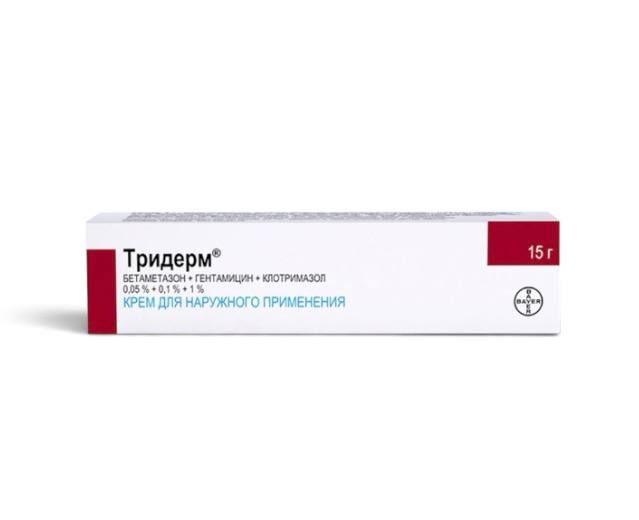
Triderm (Betamethasone + Gentamicin + Clotrimazole) 0.05% + 0.1% + 1% 15 g cream
€23
Betamethasone 0.05% + gentamicin 0.1% + clotrimazole 1%, 15 g cream — triple-combination topical (corticosteroid + antibiotic + antifungal) for infected dermatoses, eczema and dermatomycoses (supplied from Belarus)
In stock
Triderm (Betamethasone + Gentamicin + Clotrimazole) 0.05% + 0.1% + 1% 15 g cream
Product Details
Triderm (Betamethasone + Gentamicin + Clotrimazole) 0.05% + 0.1% + 1%, 15 g cream — Bayer
Triderm is a combined medicine for external use. One gram of cream contains betamethasone dipropionate (micronised) 0.643 mg, equivalent to 0.5 mg betamethasone — a topical corticosteroid; gentamicin sulfate 1.69 mg, equivalent to 1 mg (1000 IU) gentamicin base — an aminoglycoside antibiotic; and clotrimazole (micronised) 10 mg — an antifungal. The pack holds one 15 g aluminium tube together with the patient information leaflet in a cardboard box. The marketing-authorisation holder is Bayer; the cream is manufactured in the European Union (Famar A.V.E., Avlona, Greece) and supplied from Belarus. Triderm is intended for dermatoses that are complicated, or suspected to be complicated, by an infection sensitive to its components, and is used as directed by a doctor.
Product overview
- Trade name: Triderm (Тридерм), cream for external use
- Active ingredients: betamethasone dipropionate 0.05% / gentamicin sulfate 0.1% / clotrimazole 1%
- Composition per 1 g: betamethasone dipropionate (micronised) 0.643 mg (equivalent to 0.5 mg betamethasone); gentamicin sulfate 1.69 mg (equivalent to 1 mg / 1000 IU gentamicin base); clotrimazole (micronised) 10 mg
- Strength: betamethasone 0.05% + gentamicin 0.1% + clotrimazole 1%
- Dosage form: cream for external use — smooth, uniform, white to almost white
- Pack size: 15 g in an aluminium tube (epoxy-lacquered, with a membrane and a PE cap with a spike), 1 tube in a cardboard box
- Pharmacological group: corticosteroids for dermatological use in combination with antibiotics
- ATC: D07XC01 (betamethasone in combination with other medicines)
- Marketing-authorisation holder: Bayer
- Manufacturer: Famar A.V.E., Avlona, Attiki, Greece (cream) — for the ointment, Schering-Plough Labo N.V., Heist-op-den-Berg, Belgium
- Country of supply: Belarus (EU manufacture)
What Triderm is used for
Triderm is indicated in adults and in children from 2 to 18 years of age for dermatoses complicated by infections caused by organisms sensitive to betamethasone, gentamicin and clotrimazole, or where such an infection is suspected, including:
- simple and allergic dermatitis;
- atopic dermatitis (including diffuse neurodermatitis);
- eczema;
- dermatomycoses — dermatophytoses, candidiasis, tinea versicolor (pityriasis versicolor), especially when localised in the inguinal area and large skin folds;
- lichen simplex chronicus (limited neurodermatitis).
How to use
The cream is for external use only. Apply a thin layer to the entire affected skin surface and the surrounding tissue twice a day — in the morning and at night. To be effective the treatment must be applied regularly. The duration of therapy depends on the size and localisation of the lesion and on the patient's response; if there is no clinical improvement after 3–4 weeks, the diagnosis should be reviewed. In children aged 2 to 18 years the dosage regimen is the same as in adults; safety and efficacy in children under 2 years have not been established. The cream is not intended for ophthalmic use.
Possible side effects
General disorders and administration-site conditions: very rare — burning, erythema, exudation, pigmentation changes and itching. Reactions reported with topical corticosteroids (especially under occlusive dressings), frequency unknown: burning, itching, dry skin, folliculitis, hypertrichosis, acne, hypopigmentation, perioral dermatitis, allergic contact dermatitis, skin maceration, secondary infection, skin atrophy, striae, miliaria, and also systemic reactions such as blurred vision. With clotrimazole: erythema, tingling, blistering, peeling, local oedema, itching, urticaria, skin irritation. With gentamicin: transient skin irritation (erythema, itching), usually not requiring discontinuation of treatment.
Important precautions
- Contraindications: hypersensitivity to betamethasone, gentamicin, clotrimazole or any excipient; specific skin diseases (skin tuberculosis, skin manifestations of syphilis); viral diseases at the site of application (e.g. chickenpox, herpes simplex); post-vaccination skin reactions; children under 2 years of age.
- Use with caution in pregnancy (especially the first trimester), in children over 2 years, during prolonged treatment, on large areas of skin, on broken skin and under occlusive dressings (particularly in children).
- Avoid applying gentamicin to open wounds and damaged skin; cross-allergic reactions with aminoglycoside antibiotics have been reported.
- Prolonged topical use of antibiotics may lead to overgrowth of resistant flora; if irritation, sensitisation or superinfection develops, treatment should be stopped and appropriate therapy prescribed.
- The cream contains cetostearyl alcohol (may cause local skin reactions such as contact dermatitis) and propylene glycol (may irritate the skin).
- Systemic absorption is higher when large areas are treated or occlusive dressings are used. Children are more susceptible to suppression of the hypothalamic–pituitary–adrenal axis; in children the course should be limited to five days and occlusive dressings must not be used. With long-term use, withdrawal should be gradual.
- Pregnancy and breastfeeding: use only if the expected benefit for the mother outweighs the potential risk to the fetus; avoid large areas and prolonged use. It is not known whether the components pass into breast milk.
- Some adverse reactions, such as visual disturbance, may reduce psychomotor reaction and the ability to concentrate.
Storage
Store at a temperature not above 25 °C, out of the reach of children. Shelf life: 3 years. Do not use after the expiry date printed on the pack.
Important notice
This is a medicine. The information above is a short summary of the manufacturer's instruction and is not a substitute for medical advice — read the leaflet inside the pack and consult a doctor or pharmacist before use. The photograph of the pack is provided for identification purposes. If you have questions about availability or delivery, message us on WhatsApp.
📦 Ask about availability and delivery to your country on WhatsApp
You May Also Like
Display prices in:EUR